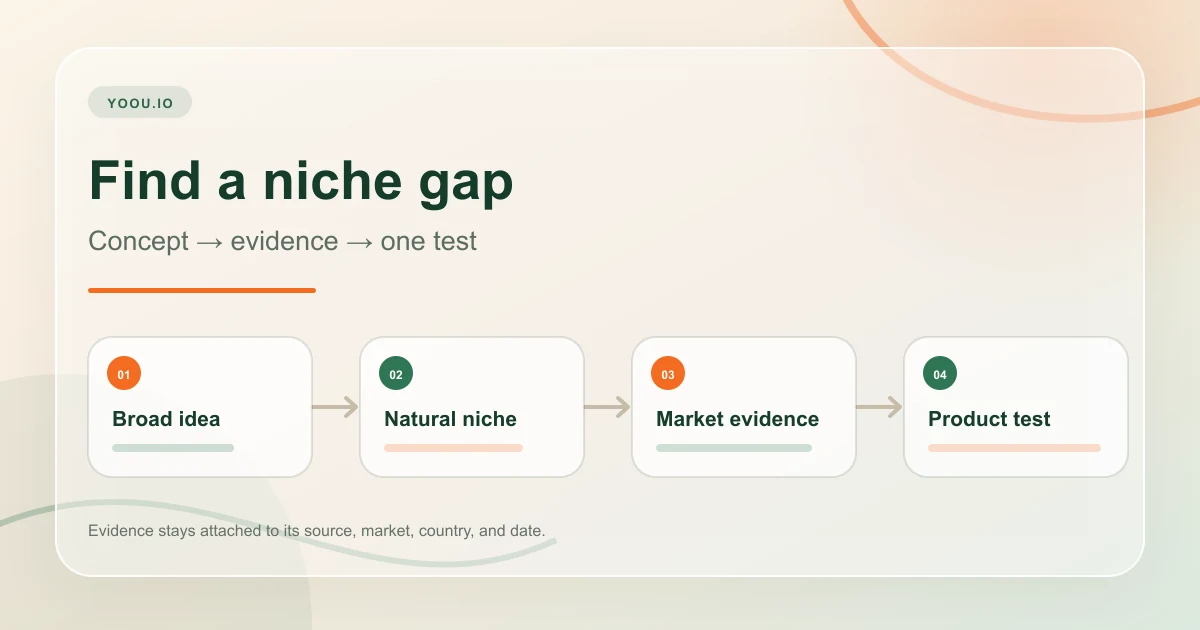
Finding low-competition print-on-demand niches is not a contest to locate the smallest result count. The useful goal is to identify a recognizable buyer and design direction, observe how it appears in a chosen marketplace, and decide whether the remaining uncertainty is small enough for one controlled product test.
Define the niche before counting products
A broad subject such as tennis, cats, or camping is a starting point, not a finished niche. A workable direction combines the subject with a natural identity, activity, style, place, life stage, or use context. The combination should describe a group or interest that a real person could recognize without needing an explanation from the seller.
Do not create artificial variety by adding gift, shirt, birthday, or funny to the same idea. Those words can help form marketplace search probes, but they do not automatically create separate niches. Keep the customer-facing direction distinct from the phrases used behind the scenes to measure it.
A quick identity check asks three questions. Does the direction preserve the original subject? Does it describe a coherent buyer or interest? Could it support several genuinely different visual concepts rather than one slogan? If the answer is no, reject it before collecting more data.
Read low supply, no results, and missing data differently
Observed supply is useful only when its source and scope remain attached. A small number of relevant products can support a limited-market hypothesis. Zero observed products can mean an unexplored idea, different buyer wording, an overly narrow phrase, or a collection problem. An unavailable collector means only that the source was not measured correctly.
| Observation | What it can support | What still remains unknown |
|---|---|---|
| Many relevant products | The direction is visibly supplied in the checked scope | Buyer demand, sales, and whether a sharper angle remains |
| A few relevant products | A small segment exists and may deserve a test | Demand strength and whether the observed sample represents the market |
| No relevant products observed | The exact wording or concept was not found in the checked scope | Whether the idea is novel, unwanted, described differently, or missed |
| Source unavailable | The collector could not produce usable evidence | Supply, demand, and the commercial decision |
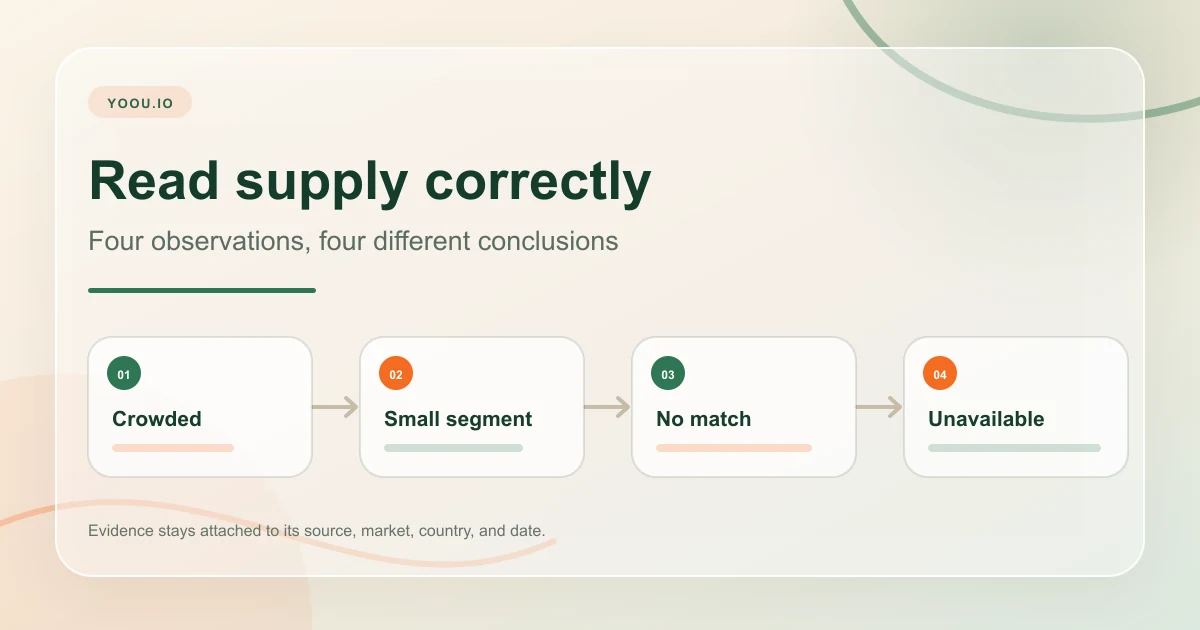
Use Niche Gaps to keep these states separate across Etsy, Redbubble, TeePublic, and Amazon. A result should preserve the selected marketplace, country, language, source status, and confidence. It should never turn an unavailable source into a low-competition claim.
Check buyer interest before calling a gap an opportunity
Supply answers only one side of the decision. Look for the terms shoppers use, marketplace search evidence when available, broader timing signals, and signs from products or queries you already control. Keep each source within its measurement boundary. Broader attention is not marketplace demand, and marketplace listings are not private sales data.
Etsy says its Marketplace Insights tool can show searches and listing counts from the stated recent window. That makes it useful for Etsy-specific questions when the seller has access. Review the official Marketplace Insights explanation instead of treating an external estimate as Etsy-owned demand data.
The trending-keyword evidence guide explains how to keep broader attention, marketplace demand, observed supply, and shop performance separate. Use Trend Radar for timing questions, then return to the marketplace before deciding what to build.
Turn the strongest direction into one reversible test
Choose no more than a few directions that pass the identity check and have usable evidence. For each one, write the buyer, visual idea, product fit, main uncertainty, and a review date. Create one design family that can be revised without rebuilding a catalog.
The test should answer a specific question. You may need to learn whether buyers respond to the visual concept, whether the wording matches marketplace language, or whether the product format makes the artwork readable. Do not change the niche, design, mockup, price, tags, and product at the same time.
Before publishing, review names, slogans, teams, characters, and brand-like phrases. A commercially interesting concept can still be unsafe to use. Keep rights research separate from demand research and stop a direction when the risk cannot be resolved.
Questions about low-competition niches
Is fewer competition always better?
No. Limited observed supply can create room to test, but it can also reflect weak demand, unusual wording, or an incomplete measurement. Keep the demand question open until another source supports it.
Does an empty marketplace search prove a first-mover opportunity?
No. It proves only that the checked query did not return relevant observed products in that scope. Try natural buyer wording and confirm collector health before deciding what the absence means.
How many niche directions should I test?
Start with the smallest set that represents genuinely different buyers or concepts. Three strong directions are more useful than eight filler variations of the same keyword.