Etsy SEO is the process of making a listing clear enough for the marketplace to match it with a relevant buyer query and persuasive enough for a shopper to keep reading. It is not a trick for repeating the same phrase. A useful workflow connects the product, buyer, occasion, style, and evidence across the whole listing.
Etsy SEO starts with one clear buyer promise
Before choosing tags, write one sentence that explains what the item is, who it is for, and why someone would choose it. A phrase such as "personalized garden journal for a new allotment owner" gives you more useful material than a broad seed such as "garden gift." It identifies the product, recipient, and context without inventing demand.
Etsy explains that query matching can consider the title, tags, categories, attributes, description, first photo, reviews, and other listing or shop signals. That means a relevant phrase cannot rescue a confusing product page by itself. Read how Etsy search works before treating any checklist as a fixed algorithm.
Map one product across the listing fields
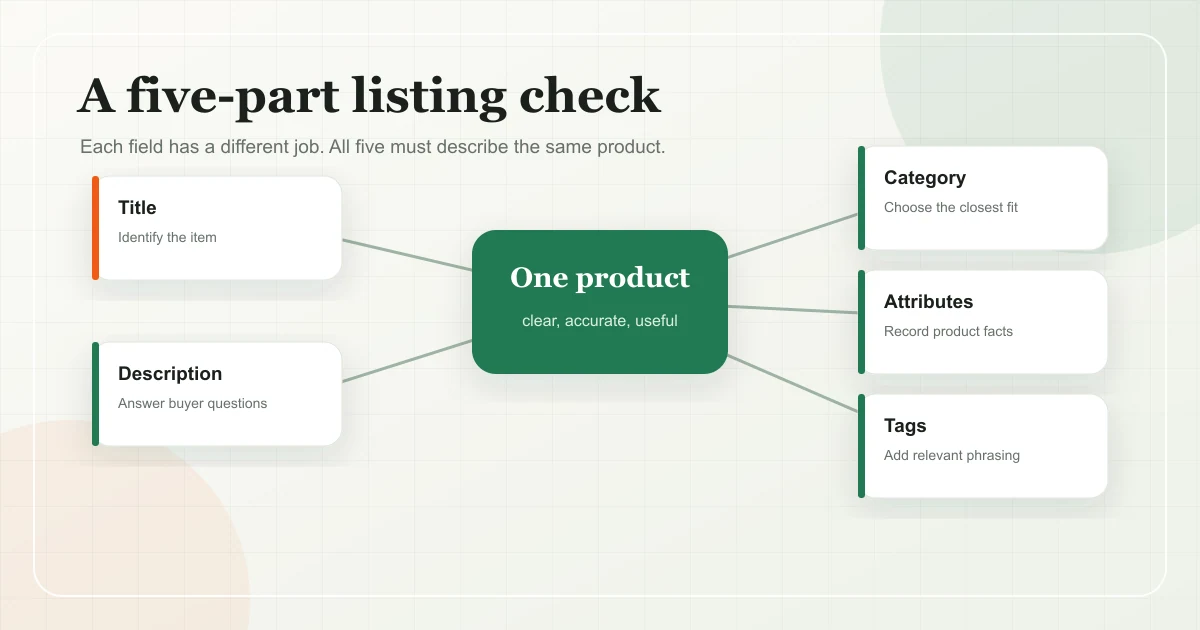
Use the same product truth across every field, but give each field a different job. The title should identify the item quickly. Categories and attributes describe structured facts. Tags widen the set of relevant phrases. The description answers the questions that remain after the photo and title.
| Listing field | Practical job | Useful check |
|---|---|---|
| Title | Explain the product in buyer-friendly language | Can a shopper identify the item without reading the tags? |
| Category | Place the item in the most specific valid branch | Is there a narrower accurate category available? |
| Attributes | Record facts such as occasion, color, or recipient when applicable | Does every selected value match the item shown? |
| Tags | Cover relevant ways a buyer might describe the same item | Does each phrase add a distinct idea? |
| Description | Clarify materials, size, use, customization, and expectations | Are important purchase questions answered naturally? |
The marketplace tag generator can help organize initial directions. Keep only suggestions that describe the real item. Its evidence label matters: a semantic suggestion is a wording idea, not measured Etsy search volume.
Use tags to expand meaning instead of repeating the title
Etsy's current guidance recommends using the available tags, adding variety, choosing relevant attributes, and categorizing specifically. Short multi-word phrases can express recipient, occasion, style, or use case. Repeating near-identical wording wastes space that could describe another genuine aspect of the product.
Start with the strongest product phrase, then inspect what is missing. A mug listing may need a recipient phrase, an occasion phrase, a visual-style phrase, and a use-case phrase. Do not add a popular event, character, brand, or slogan unless it truly applies and you have checked the rights risk. The official guidance for Etsy tags should remain the source of truth for current limits and rules.
Measure discovery and shopper response separately
A ranking check can tell you whether a listing was observed for a specific query, country, and result range. It cannot tell you total demand, sales, or profit. Use Shop Visibility for comparable observations, then use Etsy Shop Stats to see the search terms and traffic sources reported for your own shop.
The useful review question is not "Did SEO work?" Ask what changed. Did impressions appear for a relevant phrase? Did shoppers open the listing? Did favorites or orders improve after the product page became clearer? Etsy's Shop Stats guide explains where sellers can inspect how shoppers reached their listings.
Use a small revision log. Record the date, the field changed, the reason, and the next review date. Avoid changing the title, photos, price, tags, and offer at the same time because you will not know which change influenced the result.
Common Etsy SEO questions
What is Etsy SEO?
It is the work of making a listing relevant to buyer queries and useful to shoppers. Listing information, quality, service, and shopper context can all matter, so no single tag or title formula guarantees placement.
Should every tag repeat the main keyword?
No. Use accurate variations that add product, recipient, occasion, style, or use context. Remove duplicates and phrases that do not describe the item.
How quickly should I judge a listing change?
Set a review window that gives the listing a fair chance to collect impressions and visits. Compare like with like and account for seasonality before drawing a conclusion.