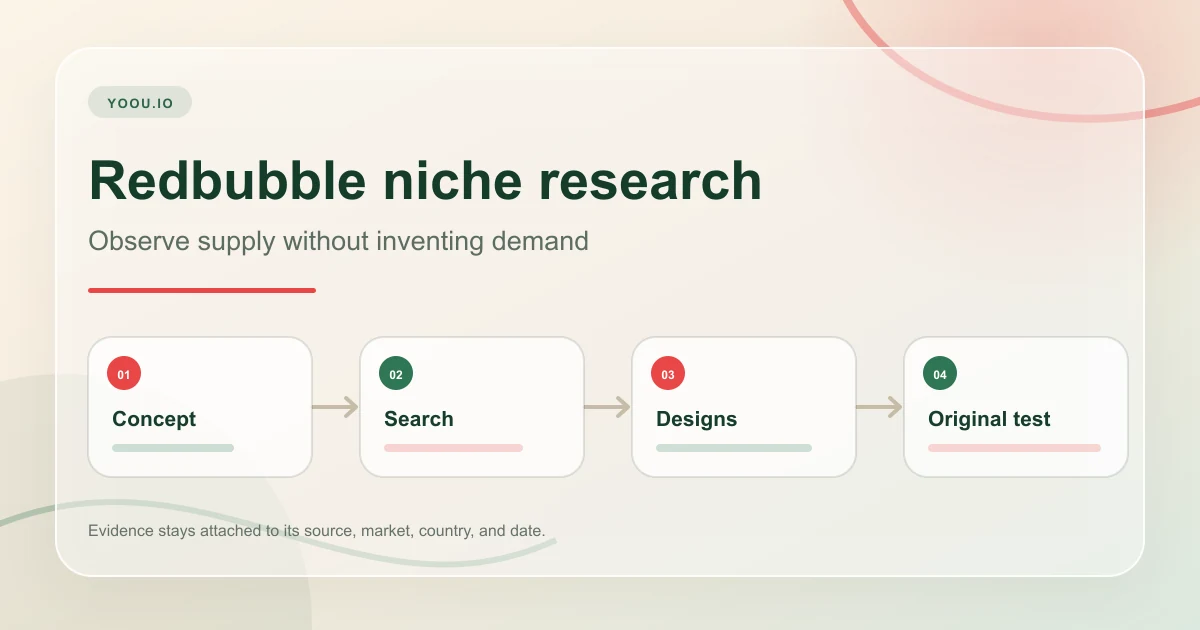
Redbubble niche research should help an artist choose what to draw and how to describe it. Search pages show visible designs, but they do not report private orders or conversion. Use them to observe relevant supply, repeated visual territory, and the terms shoppers use while keeping every unknown visible.
Define the design direction before searching
Begin with a concept that can support several original visuals. The useful unit is not a long phrase containing product and gift words. It is a coherent direction such as an interest, identity, activity, style, animal type, or natural specialization that a buyer could recognize.
Write the concept in plain language, then create a small probe set. One probe can use the exact concept. Adjacent probes can use common buyer wording while preserving the same semantic core. Stop when a broader phrase would measure only the parent topic rather than the chosen direction.
Redbubble tells shoppers they can add descriptive words and filter by product or topic. Its search help page supports using specific wording to narrow a result set. That does not mean every longer phrase is a separate market.
Count relevant designs instead of page clutter
A useful supply check should focus on relevant artwork. Exclude unrelated products, generic mockup objects, duplicated variants of the same design, and results that match only one loose word. Record whether the page loaded correctly and whether the checked country or language could influence the observation.
| Result pattern | Reader-facing conclusion | Safe next step |
|---|---|---|
| Many relevant designs | The direction is visibly represented | Look for a sharper natural specialization or stronger visual territory |
| A small relevant set | A market segment was observed | Compare natural shopper wording and test one differentiated concept |
| No relevant match | The exact direction was not observed | Try adjacent natural wording and verify source health |
| Search unavailable or challenged | Supply is unknown | Do not label the niche low competition |
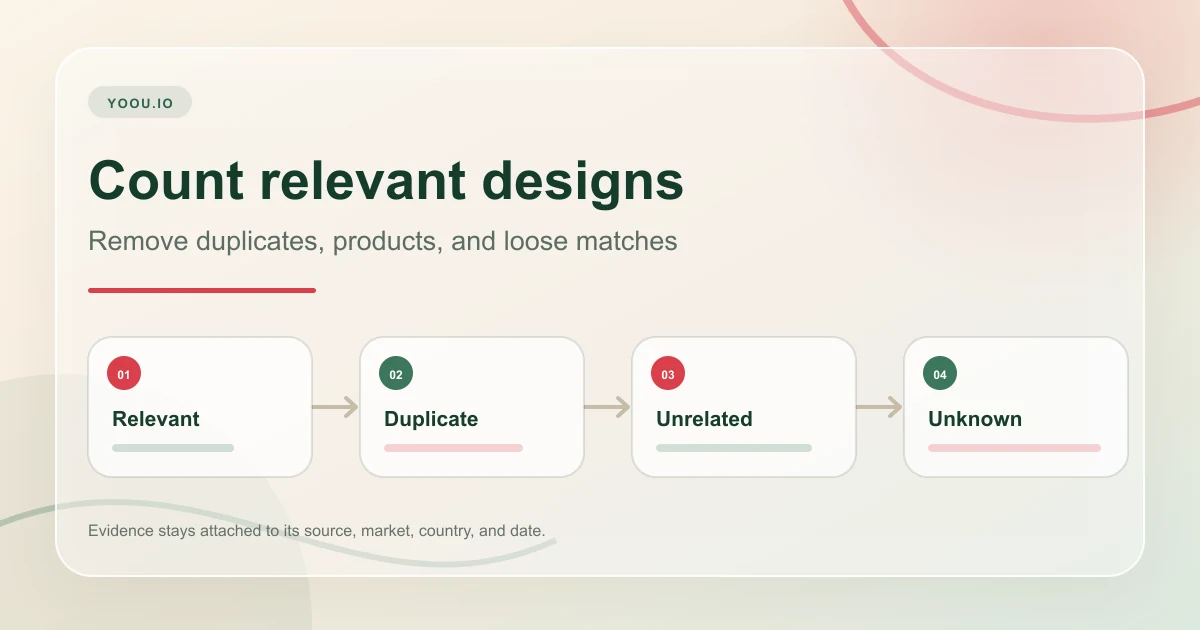
Use Niche Gaps to preserve the observation status instead of collapsing every absence into an opportunity. Compare the same concept with other marketplaces when useful, but do not assume buyer behavior is identical across them.
Use tags as description, not invented demand
Redbubble's current tag help says artists can add up to the stated number of accurate tags and should avoid tag spam. It recommends brainstorming descriptive words and narrowing them to the strongest relevant set. Check the official design-tag guidance for current limits before uploading.
Build tags from what is visibly present in the artwork: the subject, activity, style, mood, color, audience context, and meaningful related phrase. Do not add a popular event, brand, character, or identity that the design does not represent. Relevant wording helps discovery; it does not prove demand or guarantee placement.
The marketplace tag generator can organize initial wording. Review each suggestion against the final artwork, remove duplicates, and check protected names before publishing.
Choose a visual territory worth testing
After observing supply, define what your design will do differently without copying another artist. The difference may come from a visual metaphor, composition, medium, tone, or a legitimate subculture detail. It should be visible in the artwork, not only in the title.
Write a brief with the audience, central image, style, product fit, words to explore, and main risk. Then use Design Studio to develop one original direction. Review the result on several enabled products and keep only formats where the focal detail remains readable.
Set a review point based on information you can actually observe in your account. A result page can support a supply observation. Your own analytics and sales history support conclusions about your shop. Keep those evidence types separate.
Redbubble niche research questions
Does a small Redbubble result set prove demand?
No. It shows limited relevant supply in the checked scope. Demand, conversion, and future sales remain unknown until supported by another source or your own results.
Should every probe include shirt or gift?
No. Product and commercial wording can help some marketplace checks, but the underlying concept should remain recognizable without those suffixes.
Can I reuse a competitor's visual because the niche looks promising?
No. Use visible results to understand repeated territory and find room for an original concept. Do not copy artwork, slogans, or protected elements.