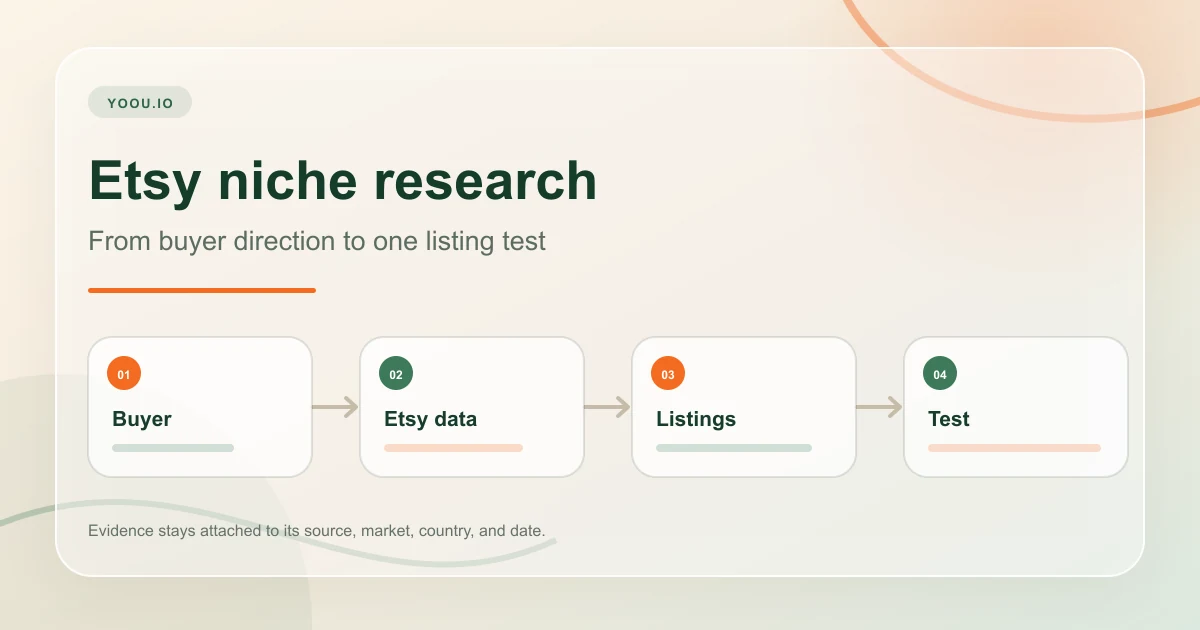
Etsy niche research for print-on-demand sellers should lead to a clear product decision, not a spreadsheet full of phrases. Start with a coherent buyer direction, use Etsy-owned data for Etsy-specific demand questions, inspect visible supply, and decide what one listing can test without claiming future sales.
Start with a buyer and product decision
Choose a subject you can translate into more than one original visual. Then define the buyer context and a suitable physical product. A gardening theme for a specific community may support prints, totes, or shirts, but the useful direction depends on how the artwork will be used and why that buyer would recognize it.
Keep the niche label separate from search wording. The niche is the market-facing concept. Search phrases are probes used to observe demand and supply. Phrases that differ only by gift, shirt, birthday, or funny usually measure the same underlying direction rather than four different niches.
Write one sentence that names the buyer, the recognizable interest, the design territory, and the first product. If the sentence sounds forced or needs several unrelated identities to become specific, the concept is probably too narrow.
Use the low-competition niche research framework when the result count looks attractive but the buyer or evidence is still unclear.
Use Etsy-owned evidence for Etsy questions
Etsy says Marketplace Insights gives sellers direct access to search data, related terms, listing counts, and recent trend information for the reported window. Use it when the question is what Etsy shoppers search for. Keep the date and window attached, because the observation is not a permanent market fact.
The official Marketplace Insights guide also notes that visible search terms are not automatically allowed. Demand research does not replace policy or rights review. Etsy's Keywords 101 guidance recommends relevant, varied wording and explains why specific phrases can match clearer buyer intent.
| Research question | Best evidence | Caution |
|---|---|---|
| Are Etsy shoppers using this phrase? | Etsy Marketplace Insights when available | Preserve the reported time window |
| How much supply appears? | A scoped observation of relevant Etsy results | The observation is not a private sales metric |
| Does the product fit the buyer? | Listing review and an original mockup | A keyword cannot fix weak product fit |
| Did my test attract qualified visits? | Your own Etsy Shop Stats | One shop does not describe the whole market |
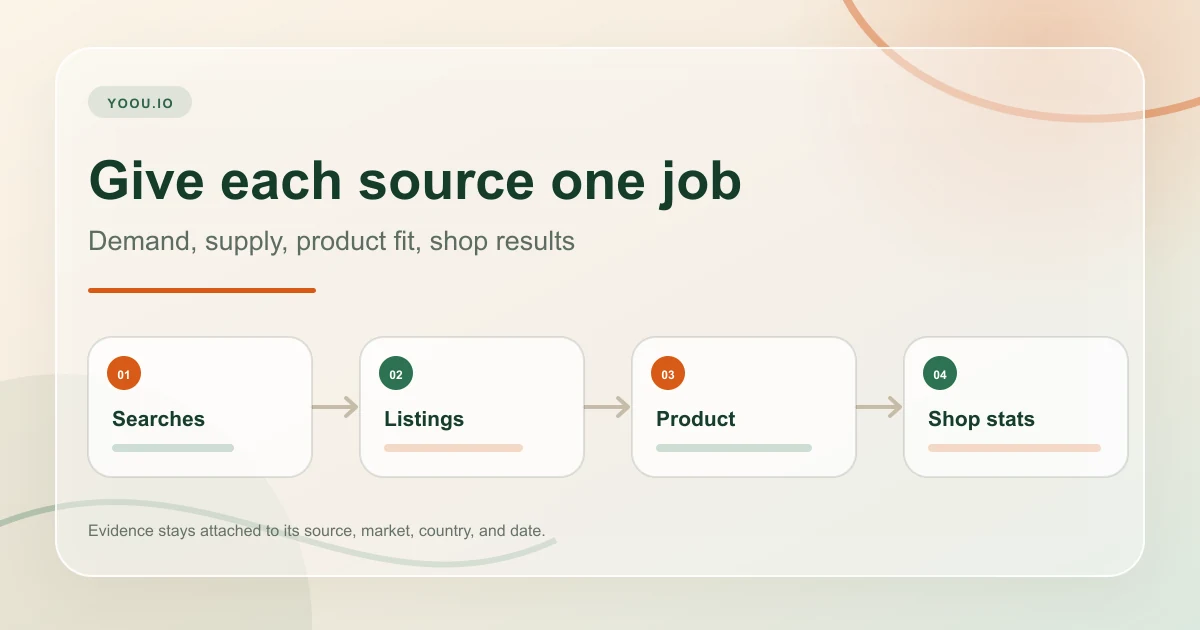
Use the Niche Gaps marketplace comparison to organize candidate directions and evidence states. Treat its supply observations as research support, not Etsy search volume or a forecast.
Inspect listings for differentiation, not imitation
Review enough relevant results to understand repeated product formats, visual structures, audiences, and wording. Remove unrelated objects, supplies, and generic thumbnails from the comparison. The purpose is to see what the checked market already communicates, not to copy a leading seller.
Look for an unmet buyer question or a visual territory that remains legible on the intended product. A direction may still be crowded even when exact wording is rare. Similar designs can use different titles, and personalized results can vary by shopper.
Etsy explains that search uses listing information holistically and that results can be personalized. Read how Etsy search works before treating your own manual search position as a stable ranking measurement.
Build one Etsy listing test you can learn from
Choose one concept with a clear buyer, accurate wording, suitable product, and manageable rights risk. Create an original visual and a listing that explains the delivered item. Use the Etsy listing system to align the title, tags, category, attributes, description, and first image.
Record what the test is meant to learn and when you will review it. Use your own shop statistics for impressions, visits, search terms, favorites, and orders that Etsy reports. If the test underperforms, change one meaningful variable rather than multiplying the same unproven idea across a catalog.
Etsy niche research questions
Is a low Etsy listing count enough to choose a niche?
No. It can support a supply observation, but you still need buyer-interest evidence, a coherent concept, product fit, and a rights review.
Should I search only the exact niche label?
No. Use a small group of natural buyer phrases that preserve the concept. Different wording can reveal related supply without turning every phrase into a separate niche.
Can I judge a niche by searching Etsy while logged in?
Use that search as one observation. Etsy says results can be personalized, so combine it with Etsy-owned insights and your own shop data when available.