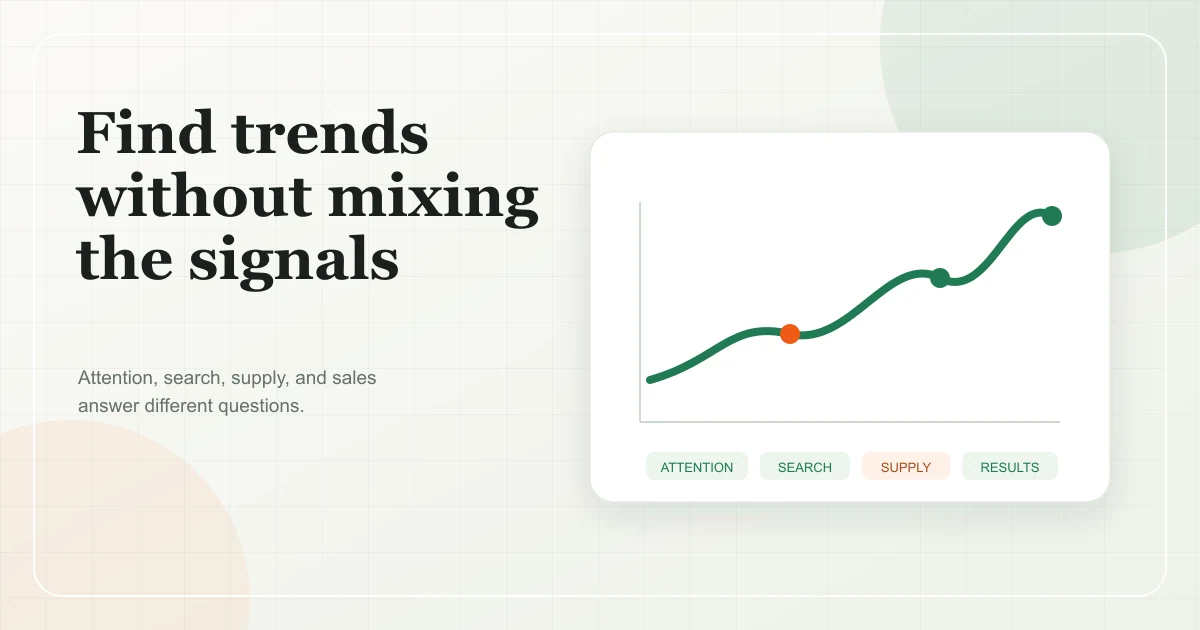
Knowing how to find trending keywords is useful only when you can explain what made a phrase look promising. A social spike, an Etsy search trend, a crowded results page, and visits to your own shop measure different things. Keep those signals separate before deciding what to design or change.
Start by naming the signal you need
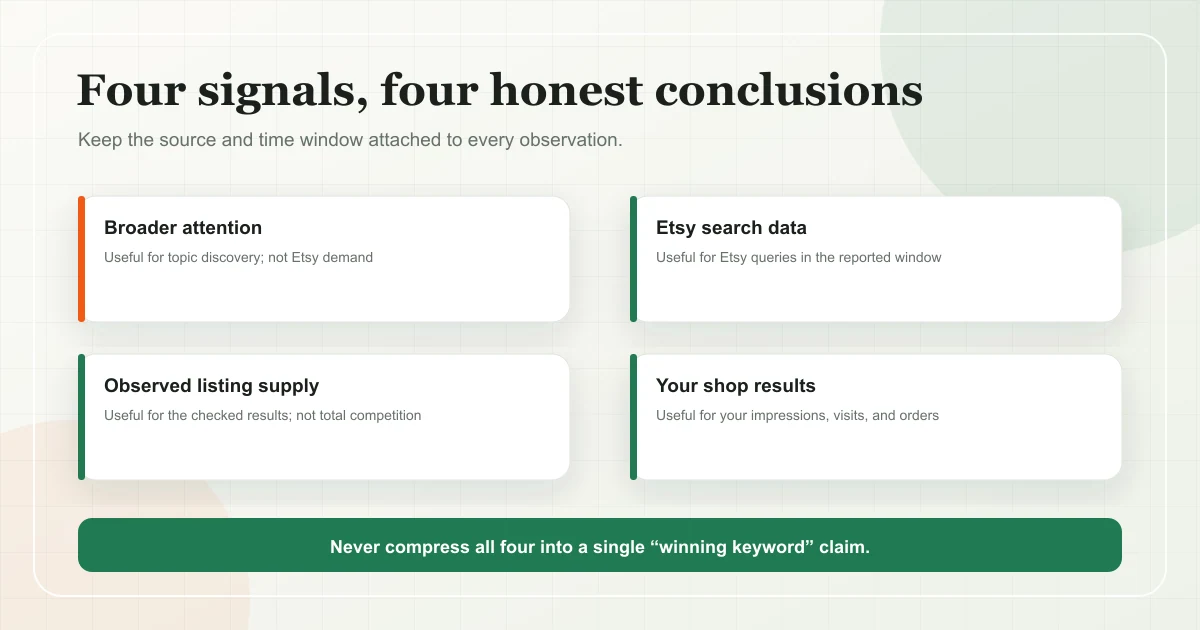
Use broader attention signals when you need topic discovery. Use marketplace search data when you need evidence about searches inside that marketplace. Use observed listings when you need a view of current supply. Use your own shop analytics when you need to understand impressions, visits, and orders for products you control.
A phrase can rise on the open web without becoming an Etsy buying query. It can also appear frequently in marketplace listings without showing strong buyer demand. Neither observation is useless; each answers a different question.
| Signal | What it can support | What it does not prove |
|---|---|---|
| Broader attention | Topic discovery and timing questions | Etsy search volume or sales |
| Etsy Marketplace Insights | Etsy searches, related terms, and listings for the reported window | Future sales or legal eligibility |
| Observed listing supply | Whether related products appear in the checked results | Total competition, private sales, or conversion |
| Your shop analytics | How shoppers reached and used your own listings | The performance of every competing shop |
Use Etsy-owned data for Etsy-specific questions
Etsy says Marketplace Insights gives sellers access to real Etsy search data, related terms, listing counts, and trends from the reported recent window. Use that source when the question is specifically what buyers search for on Etsy. Its help page also warns that a visible search term is not automatically allowed, so policy and rights checks remain the seller's responsibility.
Review Etsy's Marketplace Insights help for current access and fields. Etsy's guide to spotting trends and keywords explains how the data can inform listings and inventory without updating anything automatically.
Compare the topic with products already visible
Once a topic passes the demand check, inspect how it appears on products. The goal is not to copy the most common phrase or visual. Look for buyer contexts that are underserved, product formats where the idea remains readable, and wording risks that should stop the concept.
Use Trend Radar to discover broader topics and compare observed supply across supported marketplaces. The tool keeps demand signals and listing observations separate. A marketplace availability check is not relabeled as Etsy search volume or sales.
For a focused query, Shop Visibility can record listing positions observed in the country and result range selected. Use the same query and scope when comparing checks. A missing result means it was not found in the pages checked, not that it is absent from the marketplace.
How to find trending keywords with a reversible product test
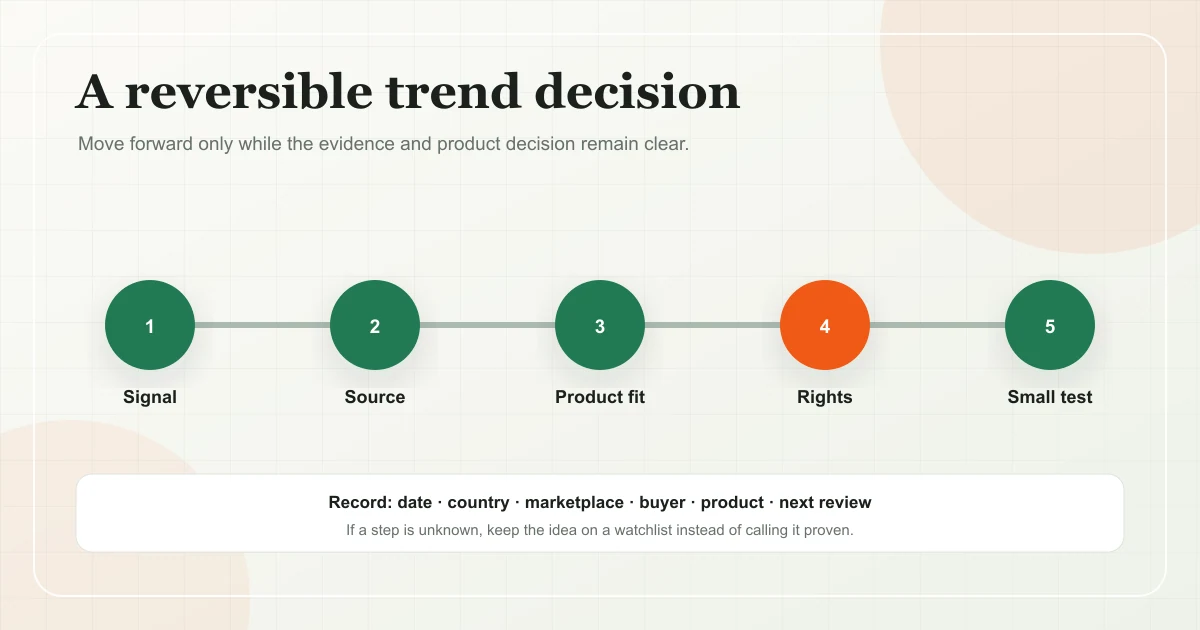
Write a one-page decision note before creating the artwork. Record the signal source, date, country, marketplace, buyer, product, rights risk, and next review date. Then choose one product direction that can be stopped or revised without rebuilding a full catalog.
Etsy's seasonal trend reports can provide useful category context. Their figures are tied to stated dates, markets, and comparison windows, so preserve those boundaries when using them. The Spring and Summer 2026 report, for example, describes its internal search and sales data as directional and date-specific.
Before publishing, check names, slogans, characters, and brand-like wording in the official trademark-search workflow. A trend can be commercially interesting and still be unusable for the product you planned.
Trending keyword research questions
Are trending keywords the same as high-volume Etsy searches?
No. A trend may come from broader attention or another source. Use Etsy-owned search data for Etsy-specific demand questions and keep the source and time window attached.
Does low observed supply mean low competition?
Not automatically. It describes only what was observed in the checked scope. Unchecked pages, wording variations, listing quality, and private performance remain unknown.
When should I act on a rising phrase?
Act when the signal is relevant to a specific buyer and product, the timing still works, the evidence is strong enough for a small test, and the wording passes a rights review.